


Page 24 - Bespoke EPG 2017 Digital
P. 24
■■ At least one independent outsider trustee should be co-appointed as trustee
    to every trust in which (a) the trustees are all beneficiaries and (b) the
    beneficiaries are all related to each other.

■■ A trustee can be a beneficiary of a trust, but a sole trustee may not also be
    a sole beneficiary of a trust, as a trustee by definition holds and administers
    property for some person other than himself.

Taxation of trusts
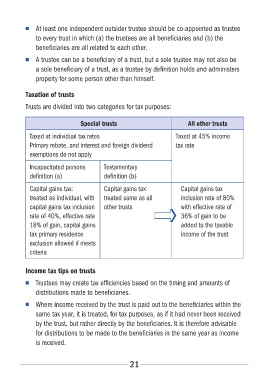
Trusts are divided into two categories for tax purposes:

Special trusts                                                 All other trusts
                                                          Taxed at 45% income
Taxed at individual tax rates                             tax rate
Primary rebate, and interest and foreign dividend
exemptions do not apply                                     Capital gains tax
                                                            inclusion rate of 80%
Incapacitated persons        Testamentary                   with effective rate of
definition (a)               definition (b)                 36% of gain to be
                                                            added to the taxable
Capital gains tax:           Capital gains tax:             income of the trust
treated as individual, with  treated same as all
capital gains tax inclusion  other trusts
rate of 40%, effective rate
18% of gain, capital gains
tax primary residence
exclusion allowed if meets
criteria

Income tax tips on trusts

■■ Trustees may create tax efficiencies based on the timing and amounts of
    distributions made to beneficiaries.

■■ Where income received by the trust is paid out to the beneficiaries within the
    same tax year, it is treated, for tax purposes, as if it had never been received
    by the trust, but rather directly by the beneficiaries. It is therefore advisable
    for distributions to be made to the beneficiaries in the same year as income
    is received.

                             21

